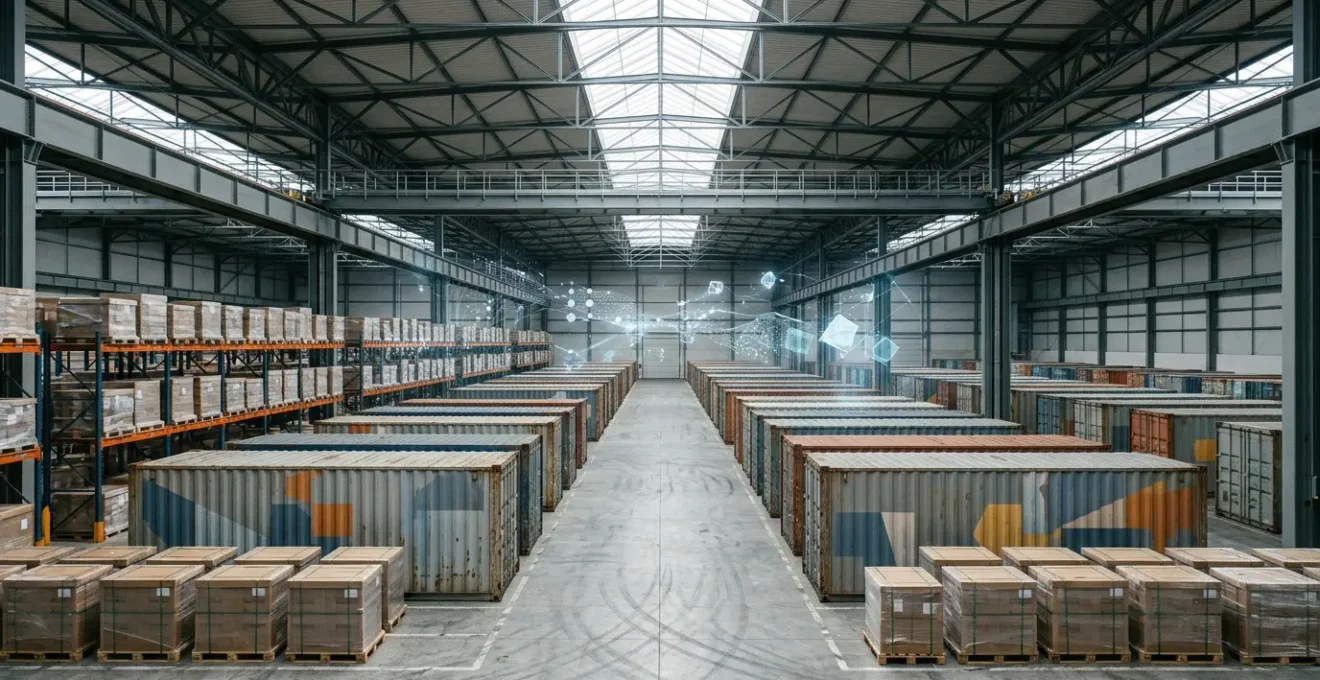
Contrary to popular belief, blockchain’s primary value isn’t just ‘transparency’—it’s the creation of computational trust, a system where reliability is guaranteed by code, not by intermediaries.
- Immutable ledgers and smart contracts replace manual verification, making fraud and disputes nearly impossible.
- Permissioned networks provide the privacy and control enterprises need, while decentralized identity verifies every actor in the chain.
Recommendation: Instead of asking ‘how can we be more transparent?’, leaders should ask ‘which high-risk, low-trust process can we fully automate with verifiable, computational rules?’.
For any Supply Chain Director, the word « trust » is fraught with complexity. It implies reliance on partners, third-party verifiers, and endless paper trails, each representing a potential point of failure, fraud, or delay. The common industry conversation suggests that blockchain technology is the solution, promising a new era of « transparency. » But this focus on transparency alone misses the point. Simply seeing a problem on a shared ledger is only half the battle. The true revolution isn’t just about visibility; it’s about fundamentally eliminating the need for traditional, human-mediated trust altogether.
The real opportunity lies in building systems based on computational trust. This is a paradigm shift where reliability is no longer an assumed quality of a partner but a verifiable property of the network itself. Through cryptographic proof and automated smart contracts, we can design supply chains that are not just transparent, but self-enforcing and provably honest. This framework doesn’t just streamline operations by removing middlemen; it re-engineers the economic and risk models that govern relationships between suppliers, manufacturers, and customers.
This article moves beyond the hype to provide a strategic overview for leaders. We will dissect the core components that enable this new trust architecture, from the foundational choice of network to the critical importance of data integrity and scalable design. We will explore how these technologies combine to create a supply chain where transactions are not just recorded, but are guaranteed to be authentic and immutable.
To navigate these strategic considerations, this article is structured to guide you from foundational concepts to practical applications. The following sections break down how to build a robust, trustless framework for your supply chain.
Summary: Building a Blockchain-Powered Trust Architecture
- Permissioned vs Public Blockchain: Which Fits Enterprise Privacy Needs?
- The Smart Contract Bug That Locked Millions in Assets
- How to Use Blockchain to Prove the Origin of Raw Materials?
- Why « Trustless » Systems Actually Create More Reliability Between Strangers?
- Layer 2 Solutions: Scaling Blockchain Transactions for Enterprise Volume
- Why Decentralized Identity Wallets Are the Future of Verification?
- How to Clean Your Data Before Importing It Into a New ERP?
- Decentralized Ledger Technologies: How to Ensure Immutable Record Keeping?
Permissioned vs Public Blockchain: Which Fits Enterprise Privacy Needs?
The first strategic decision in building a trust framework is selecting the right type of blockchain. While public blockchains like Bitcoin are famous for their open, anonymous nature, they are rarely suitable for enterprise supply chains. The need for confidentiality, control over participants, and regulatory compliance points decisively toward permissioned blockchains. In these networks, only authorized and identified parties can participate, view transactions, and validate data. This « walled garden » approach is not a limitation but a critical feature for business.
A permissioned model allows a consortium of supply chain partners—say, a manufacturer, its key suppliers, and its logistics providers—to create a shared, immutable ledger without exposing sensitive commercial data to the public. It transforms the blockchain from a public utility into a secure, private data-sharing infrastructure. This focus on enterprise needs is why market data shows that nearly 68% of enterprise blockchain revenue flows through permissioned networks. They provide the perfect balance between decentralized trust and centralized governance.

As this visualization suggests, governance models exist on a spectrum. The key is finding the right balance of transparency and access control. Expert analysis confirms the advantages of this controlled environment. As a recent study from the MDPI Electronics Journal highlights:
Permissioned blockchains offer a secure and trusted platform for data sharing and collaboration while protecting the confidentiality of sensitive information by implementing privacy-enhancing features such as encryption, zero-knowledge proofs, and ring signatures.
– Research Team, MDPI Electronics Journal – Permissioned Blockchain Privacy Study
This ability to enforce privacy rules at a protocol level is fundamental. It ensures that partners can collaborate with confidence, knowing that their trade secrets and pricing information are not exposed, while still benefiting from a single source of truth for shared processes like order fulfillment and customs clearance.
The Smart Contract Bug That Locked Millions in Assets
While a permissioned blockchain provides a secure foundation, the logic that runs on top of it—smart contracts—introduces a new and critical risk factor. A smart contract is self-executing code that automates agreements and transactions. Once deployed on the blockchain, its rules are immutable. This is its greatest strength and its most significant vulnerability. If the code contains a flaw, that flaw is also immutable and can be exploited with devastating consequences. A secure system requires not just a robust network, but provably correct code.
The history of blockchain is littered with examples of costly bugs. These aren’t just theoretical risks; they have led to the loss of hundreds of millions of dollars and serve as a stark warning for any enterprise implementation. The concept of « code is law » means there is no central authority to appeal to if a contract is exploited due to a bug. The protocol will execute as written, even if the outcome is catastrophic.
Case Study: The BonqDAO Price Oracle Exploit
The DeFi protocol BonqDAO provides a chilling real-world example of this danger. Due to a smart contract vulnerability in its price oracle—the mechanism that feeds external data into the blockchain—an attacker was able to manipulate the price of a digital asset. As detailed in an analysis of the smart contract vulnerability, the attacker exploited this flaw to steal approximately 100 million $BEUR stablecoins and 120 million $WALBT tokens. This incident demonstrates how a single, overlooked error in code can compromise an entire financial system built on the blockchain, underscoring the absolute necessity of rigorous, third-party code audits before deployment.
For a Supply Chain Director, the lesson is clear: implementing blockchain is as much a software security project as it is a logistics project. The budget and timeline must account for multiple rounds of independent code audits, formal verification, and penetration testing. The goal is to build systems where the automated trust is not blind, but is based on code that has been rigorously vetted to be free of logical errors and economic exploits.
How to Use Blockchain to Prove the Origin of Raw Materials?
One of the most powerful applications of a well-architected blockchain framework is establishing an unbreakable chain of custody for products and raw materials. This capability, known as provenance tracking, directly addresses critical business challenges like counterfeiting, regulatory compliance (e.g., for conflict minerals), and meeting consumer demand for ethical sourcing. By creating a digital token or « twin » for a physical asset at its point of origin, every subsequent movement, transformation, or change of ownership can be recorded as an immutable transaction on the ledger.
This creates a digital passport for each item, accessible to all permissioned parties. A retailer can instantly verify the authenticity of a luxury good, a food manufacturer can trace an ingredient back to the farm in seconds during a recall, and a regulator can audit the entire journey of a pharmaceutical product. This use case is so compelling that product traceability captures 24.5% of the market share in blockchain supply chain applications, making it the dominant driver of adoption.
Case Study: The Aura Blockchain Consortium’s Fight Against Counterfeiting
The luxury goods sector, plagued by sophisticated counterfeits, offers a powerful example. The Aura Blockchain Consortium, founded by brands like Louis Vuitton, Prada, and Cartier, uses a shared permissioned blockchain to certify the authenticity of its products. In 2024, the OTB group (owner of Marni and Jil Sander) became the first member to deploy these blockchain-based digital certificates of authenticity across all its luxury brands. Each product is issued a unique, tamper-proof digital certificate that traces its journey from manufacturing to retail. This not only proves authenticity to the end consumer but also provides a unified, trusted record for all partners in the value chain, demonstrating a clear ROI by protecting brand value and combating the grey market.
Implementing such a system requires more than just technology; it requires standardizing data inputs at the source. Whether it’s a QR code on a component, an NFC tag on a pallet, or an IoT sensor in a shipping container, the link between the physical asset and its digital twin must be secure and reliable. When executed correctly, the result is a verifiable product history that no single party can alter or dispute.
Why « Trustless » Systems Actually Create More Reliability Between Strangers?
The term « trustless » is one of the most misunderstood yet powerful concepts in blockchain. It does not mean the system is untrustworthy; it means the system is so reliable that participants do not need to trust each other to transact safely. Traditional commerce is built on trust intermediaries: banks, auditors, lawyers, and escrow agents who vouch for transactions and resolve disputes. Blockchain replaces this human-intermediated trust with computational trust. Reliability is achieved not through reputation, but through shared, transparent rules enforced by cryptography and consensus.
In a trustless system, your confidence comes from the verifiable mathematics of the protocol itself. As Deloitte notes in a report on supply chain innovation, « Blockchain is a tamper-evident ledger that provides a trusted shared and reliable way to record, validate, and view transactions across a complex system with many participants, some of whom may not inherently trust each other. » This is a game-changer for global supply chains, where visibility is often limited. With 60% of companies lacking visibility beyond their tier-1 suppliers, the ability to securely transact with a tier-3 supplier you’ve never met is revolutionary.
Blockchain is a tamper-evident ledger that provides a trusted shared and reliable way to record, validate, and view transactions across a complex system with many participants, some of whom may not inherently trust each other.
– Deloitte Consulting, Deloitte – Blockchain Supply Chain Innovation Report
Imagine a scenario where payment to a supplier is automatically released by a smart contract the moment an IoT sensor on a shipping container confirms its arrival at a port. No invoices to process, no net-60 payment terms, no disputes over delivery times. The agreement is executed automatically based on verifiable data. This systemic reliability reduces the immense administrative overhead and financial risk that plague supply chains, which on average cost organizations $184M annually in disruptions. In this new model, trust is an emergent property of the system, not a prerequisite for participation.
Layer 2 Solutions: Scaling Blockchain Transactions for Enterprise Volume
A common and valid criticism of early blockchains is their limited transaction throughput. A global supply chain for a major retailer might generate thousands of data points per minute—a volume that would overwhelm a traditional blockchain like Ethereum, which can only process a handful of transactions per second. This scalability challenge was a major barrier to enterprise adoption. The solution lies in Layer 2 (L2) scaling solutions.
Layer 2 refers to a framework or protocol built on top of a primary blockchain (Layer 1). The core idea is to offload the bulk of the transactional work from the main chain. Instead of recording every single event on the Layer 1 ledger, thousands of transactions can be processed, batched, and verified on a faster, cheaper Layer 2 network. Then, only a single, compressed proof of these transactions is periodically anchored to the main, highly secure Layer 1 blockchain. This gives you the best of both worlds: the massive throughput of a dedicated processing layer and the ultimate security and immutability of the underlying mainnet.

This layered architecture is essential for any serious enterprise deployment. It allows the system to handle the high-frequency events typical of a supply chain—like a sensor updating its temperature every minute—without incurring prohibitive costs or network congestion. The massive investment pouring into the sector, with the market projected to grow from USD 2.26 billion in 2023 to USD 192.93 billion by 2030, is largely predicated on the success of these scaling solutions. They are what make blockchain technologically and economically viable at an enterprise scale.
For a Supply Chain Director, this means that when evaluating blockchain platforms, it’s critical to look beyond the Layer 1 protocol and inquire about its Layer 2 strategy. Solutions like optimistic rollups and zero-knowledge rollups (ZK-rollups) offer different trade-offs in terms of speed, cost, and security, and the right choice will depend on the specific use case.
Why Decentralized Identity Wallets Are the Future of Verification?
A truly secure supply chain requires more than just tracking assets; it requires verifying the identities of the people and organizations handling them. Traditional identity systems rely on centralized authorities (like governments or corporations) to issue and manage credentials. This creates data silos and single points of failure. Decentralized Identity (DID) offers a fundamentally new model where individuals and entities control their own digital identity in a secure, portable wallet.
Using a DID wallet, a shipping agent, a customs official, or even an entire company can hold and present verifiable credentials. These are tamper-proof, digitally signed claims about their identity or qualifications—for example, a credential proving they are a certified forklift operator, or another one confirming their employment with a specific logistics firm. When they need to prove their identity to interact with the supply chain, they can present only the specific credential required without revealing any other personal information. This enhances both security and privacy.
The adoption of this technology is accelerating as businesses recognize its power. As analysts at Emergen Research note, « Supply chain players are increasingly adopting decentralized identity (DID) networks and verifiable credentials to authenticate shipping agents, buyers, and suppliers. » The market for DID is exploding, with some projections valuing it at over $7 billion by 2026. This growth is driven by the need for a more robust way to manage access and authorization in complex, multi-party systems.
Supply chain players are increasingly adopting decentralized identity (DID) networks and verifiable credentials to authenticate shipping agents, buyers, and suppliers.
– Emergen Research Analysts, Emergen Research – Blockchain Supply Chain Market Trends Report
For a supply chain, this means you can cryptographically verify that the person signing for a high-value shipment is who they claim to be and is authorized to do so, without relying on a corporate badge or a paper ID. It extends the trustless framework from assets to the actors themselves, creating a comprehensive, end-to-end verification system.
How to Clean Your Data Before Importing It Into a New ERP?
A blockchain ledger is immutable. This means that while correct data is permanently and reliably stored, incorrect data is also permanently and reliably stored. The « Garbage In, Garbage Out » principle applies with a vengeance. The integrity of a blockchain-based supply chain system is therefore entirely dependent on the quality and accuracy of the data that is fed into it. This makes pre-chain data validation arguably the most critical operational challenge in any implementation.
Before a transaction is written to the blockchain, it must be subjected to rigorous cleansing and validation rules. This process often occurs in a middleware layer that sits between your existing enterprise systems (like an ERP) and the blockchain network. This layer is responsible for standardizing data formats from different partners, checking for errors or anomalies, and enforcing business rules. For example, a validation rule might reject a shipment record if the stated weight is outside a plausible range or if the shipping date precedes the manufacturing date.
Integrating data from dozens of partners, each with their own systems and standards, is a monumental task. The key is to establish clear data governance policies and use technology to automate enforcement. This includes everything from deploying tamper-proof IoT sensors for automated data capture (minimizing human error) to creating multi-source consensus models where a transaction is only committed after the same data is received from two or more independent sources. The goal is to create a robust data integrity firewall around the blockchain.
Your Pre-Chain Data Validation Action Plan
- Standardize Formats: Establish mandatory data formats for all supply chain partners, enforced via an API gateway to ensure consistency from the start.
- Implement Validation Rules: Create automated validation rules in a middleware layer to catch errors (e.g., incorrect dates, out-of-range values) before data hits the blockchain.
- Cross-Reference Sources: Design a multi-source consensus model where critical transactions are only written to the chain after data from at least two independent sources are cross-referenced.
- Ensure Accountability: Design a clear, digital trail of accountability for all data entry at the point of origin, linking every data point to a specific user or device.
- Automate Capture: Deploy tamper-proof IoT sensors for automatic data capture of key metrics (like temperature, location, or weight) to minimize human entry errors.
Without this disciplined approach to data hygiene, the blockchain will simply become a permanent, immutable record of your existing operational errors. True trust can only be built on a foundation of clean, reliable data.
Key takeaways
- Computational trust, based on code and cryptography, is more reliable and scalable than traditional human-intermediated trust.
- Permissioned blockchains provide the necessary privacy and governance for enterprise use, but require rigorous smart contract audits to prevent costly exploits.
- True supply chain integrity depends not just on the blockchain itself, but on robust pre-chain data validation to ensure only clean data is recorded.
Decentralized Ledger Technologies: How to Ensure Immutable Record Keeping?
The ultimate promise of decentralized ledger technologies (DLTs), including blockchain, is the creation of a permanent, unchangeable record of truth. This property, known as immutability, is what makes the entire trust framework possible. It is achieved through a combination of cryptographic hashing and distributed consensus. Each block of transactions is cryptographically linked to the one before it, forming a chain. Altering a historical transaction would require changing that block and every single block that came after it, an act that is computationally infeasible.
This cryptographic security is then amplified by decentralization. Because the ledger is copied and stored across numerous computers in the network, a hacker cannot simply alter one copy. They would need to simultaneously attack a majority of the network’s computers, all while re-calculating the entire chain of cryptographic hashes. As the Seko Logistics research team puts it, « Once data enters the blockchain, it cannot be tampered with, which means everyone in the network can trust its integrity. » This is why adoption is growing, with research showing that in 2023, more than 45% of major U.S. logistics and retail organizations had piloted or implemented blockchain.

For a Supply Chain Director, this has profound implications. It means creating an audit trail that is not just reliable but provably tamper-proof. In the event of a dispute, a product recall, or a regulatory inquiry, there is a single, undisputed record that all parties agreed to in real-time. There are no conflicting versions of the truth stored in different corporate silos. This dramatically reduces the time and cost associated with dispute resolution, compliance reporting, and audits.
Once data enters the blockchain, it cannot be tampered with, which means everyone in the network can trust its integrity. Data is spread across many computers, which makes it difficult for hackers to gain access.
– Seko Logistics Research Team, Seko Logistics – Blockchain Supply Chain Transparency Analysis
By combining a permissioned network, audited smart contracts, verifiable identities, and clean data, an enterprise can build a system where immutable record-keeping is the default. This is the culmination of computational trust: a supply chain that runs on verifiable facts, not on costly and fallible intermediaries.
The journey toward a fully trusted, automated supply chain is an incremental one. The next logical step is to move from theory to practice by identifying a specific, high-friction process in your own supply chain—such as customs clearance or supplier onboarding—and assessing how a decentralized trust framework could redesign it from the ground up.