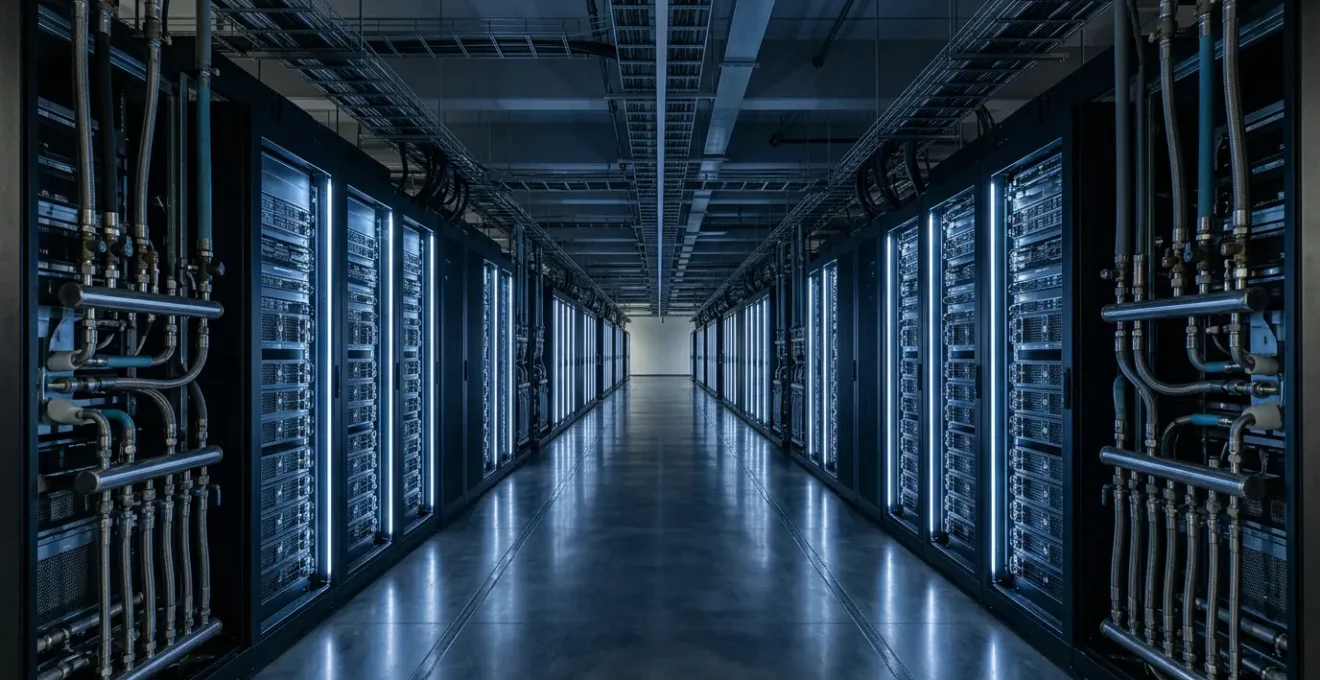
Optimizing an HPC data center is a systems engineering challenge where performance is dictated by the weakest link, not the strongest component.
- Success hinges on managing critical interdependencies between power, cooling, structural load, and network latency.
- A low Power Usage Effectiveness (PUE) is a byproduct of holistic design, not the primary goal itself.
Recommendation: Shift focus from component-level upgrades to a systemic approach that anticipates how a decision in one domain, like cooling, creates new challenges in another, like structural engineering.
The insatiable computational demands of artificial intelligence and large-scale scientific modeling have pushed data center design to a critical inflection point. As research institutions and tech giants race to build the next generation of supercomputers, they face a fundamental paradox: the very components that unlock unprecedented performance, namely high-density GPUs, also generate unprecedented levels of heat and power consumption. The old design paradigms, focused on air cooling and generic efficiency metrics, are no longer sufficient.
Many facilities attempt to solve this by chasing a lower Power Usage Effectiveness (PUE) or by planning piecemeal upgrades to liquid cooling. However, these solutions often treat symptoms rather than the root cause. This article takes a different stance. The true key to optimizing an HPC data center lies not in a checklist of technologies, but in understanding and mastering the systemic interdependence between every element of the facility. It is a holistic design challenge where a seemingly isolated choice in rack layout can have cascading effects on thermal management, network performance, and even structural safety.
This guide provides a designer-centric framework for navigating these complex trade-offs. We will dissect the critical design considerations that are often overlooked, moving beyond surface-level metrics to uncover the second-order effects that truly define a facility’s performance and total cost of ownership. We will explore cooling, cost models, structural integrity, and network fabric not as separate silos, but as interconnected pillars of a unified high-performance system.
To navigate this complex topic, this article is structured to address the core challenges a designer faces. The following summary outlines the key areas we will explore, providing a roadmap for building a truly optimized HPC environment.
Summary: A Designer’s Roadmap to HPC Optimization
- Why Improving PUE Is Critical for Sustainable HPC Operations?
- How to Retrofit Liquid Cooling in Air-Cooled Data Centers?
- Cloud HPC vs On-Premise: Which Is Cheaper for Long Simulations?
- The Weight Distribution Error That Endangers High-Density Racks
- InfiniBand Implementation: Reducing Latency Between Nodes
- The Cooling Oversight That Throttles Your Server Performance
- Lease vs Buy: When Does CapEx Still Make Sense for Servers?
- Why Next-Generation GPUs Are Essential for Modern AI Training?
Why Improving PUE Is Critical for Sustainable HPC Operations?
Power Usage Effectiveness (PUE) has long been the benchmark for data center efficiency, but in the context of HPC, its significance becomes more nuanced. A low PUE is not the end goal, but rather a critical byproduct of a holistically optimized design. For HPC facilities, where power densities can exceed 30kW per rack, any inefficiency in power delivery or cooling is amplified, leading to exorbitant operational costs and a significant environmental footprint. The challenge is that the industry as a whole has struggled to make meaningful gains. In fact, recent industry analysis reveals a marginal improvement in global average PUE from 1.58 to 1.56 over the past six years.
This stagnation highlights a critical flaw in simply “chasing PUE.” A truly sustainable and cost-effective HPC operation achieves a low PUE by fundamentally re-engineering its core systems. This includes optimizing power distribution from the utility entrance to the server, and more importantly, implementing a cooling system that is precisely matched to the thermal load. The reliance on traditional air-cooling, for instance, becomes a major source of inefficiency, acting as a brake on both performance and sustainability.
The potential for improvement, however, is immense when a systemic approach is taken. As a benchmark for what is achievable, consider the following case study.
Case Study: Google’s Fleet-Wide PUE Leadership
Google reported a fleet-wide average PUE of 1.09 in 2024, demonstrating that world-class efficiency is achievable through systematic optimization of cooling systems, power distribution, and facility design. This represents one of the industry’s lowest PUE values and serves as a benchmark for sustainable HPC operations. Achieving such a figure is not the result of a single technology, but the culmination of years of integrated design focusing on every part of the power and cooling chain, proving that exceptional efficiency is a direct result of holistic engineering.
Ultimately, PUE should be viewed as a diagnostic tool, not a target in itself. A high PUE in an HPC environment signals a fundamental misalignment between the facility’s infrastructure and its computational workload. Reducing it is not just about sustainability; it’s a prerequisite for unlocking the full performance potential of the hardware and maintaining financial viability.
How to Retrofit Liquid Cooling in Air-Cooled Data Centers?
As rack densities escalate beyond the capabilities of air cooling, retrofitting liquid cooling is no longer a question of “if,” but “how.” This transition, however, is far from a simple plug-and-play upgrade; it is a significant engineering undertaking that impacts a facility’s structural, electrical, and plumbing infrastructure. A common misconception is to view it as a mere equipment swap. In reality, it demands a phased, systemic approach to avoid creating new performance bottlenecks or safety hazards. The financial investment is also substantial; industry data shows that a retrofit can cost 30-40% of the original facility investment, though the payback period from energy savings is often between two to five years.
The first step is a thorough assessment of the existing facility. This goes beyond simple space allocation. It requires detailed analysis of the switchgear ratings to ensure the electrical system can handle the load of Coolant Distribution Units (CDUs), and a structural evaluation of the raised floor’s load-bearing capacity. A single CDU, when flooded, can weigh up to three tons, demanding a floor capacity that many legacy data centers were not designed for. The following illustration shows the complexity of the components involved.
As seen in the intricate network of manifolds and fittings, a successful retrofit hinges on meticulous planning and execution. Implementing a hybrid model—where liquid cooling is deployed row by row for high-density racks while legacy equipment remains air-cooled—is often the most practical strategy. This approach simplifies plumbing runs and allows for a gradual, controlled migration. For designers, the key is to treat the retrofit as a new system design, not an add-on.
Action Plan: Phased Hybrid Retrofit Strategy
- Infrastructure Assessment: Verify switchgear ratings, calculate available capacity at each distribution level, and measure actual versus nameplate cooling capacities (note that 15-year-old equipment typically operates at only 70% of its original efficiency).
- Structural Evaluation: Engage structural engineers to assess floor loading capacity. A flooded CDU can reach 3 tons, requiring a floor capacity of at least 800kg/m², a critical detail for legacy facilities.
- Hybrid Implementation: Implement liquid cooling on a row-by-row basis to simplify plumbing runs. This allows for the coexistence of new high-density liquid-cooled racks alongside legacy air-cooled equipment that cannot be migrated.
- System Optimization: Once installed, raise chilled water temperatures to improve chiller efficiency, adjust containment strategies based on new airflow patterns, and fine-tune coolant temperatures and flow rates based on actual server loads for maximum performance.
Cloud HPC vs On-Premise: Which Is Cheaper for Long Simulations?
The “cloud vs. on-premise” debate is particularly acute for HPC workloads like scientific modeling, which often involve simulations running continuously for weeks or months. The conventional wisdom—cloud for flexibility (OpEx), on-premise for control (CapEx)—oversimplifies a complex financial and operational decision. For long-running, high-utilization workloads, the total cost of ownership (TCO) can yield surprising results. While the cloud eliminates upfront hardware costs, the cumulative operational expenses for compute hours and, critically, data storage and egress can quickly eclipse the cost of an on-premise cluster.
A key factor often underestimated in cloud TCO calculations is the cost of data. HPC simulations generate and consume massive datasets, and cloud providers charge significant egress fees for moving data out of their environment. Furthermore, high-performance storage in the cloud comes at a premium. In fact, according to comparative analysis, cloud storage can cost more than 3x its on-premise equivalent for a typical medium-sized HPC environment. This hidden cost can dramatically alter the financial equation for data-intensive research.
When analyzing TCO over a typical 3-to-5-year hardware lifecycle, the cost profiles of on-premise and cloud can converge or even invert, as shown in the following comparison based on a real-world manufacturing customer.
| Cost Factor | On-Premise HPC (512-node cluster) | Cloud HPC (equivalent capacity) |
|---|---|---|
| 3-Year TCO | €685,000 | €681,000 |
| Annual Operating Cost | Amortized CapEx + maintenance | €227,000 (70k core-hours/week at 70% utilization) |
| Initial Investment | High CapEx (hardware, facility, networking) | Low (on-boarding effort only) |
| Data Transfer Costs | None (internal network) | Significant egress fees for large datasets |
| Scalability | Limited (hardware refresh cycles) | Elastic (on-demand resources) |
| Maintenance Burden | Skilled staff required (~10%/year of hardware cost) | Managed by provider |
| Source: Manufacturing customer case study with 12,000 employees and $3B annual revenue | ||
For organizations with predictable, long-duration simulation needs, an on-premise facility offers cost stability and eliminates data egress penalties. While the cloud provides unmatched elasticity for bursting and unpredictable workloads, the economics for steady-state HPC clearly favor a thorough TCO analysis over a simple CapEx versus OpEx comparison.
The Weight Distribution Error That Endangers High-Density Racks
In the pursuit of computational density, one of the most fundamental and dangerous oversights is the management of physical weight. A modern, fully-loaded high-density rack for AI workloads can weigh as much as a small car. Indeed, data center infrastructure studies indicate that these racks can weigh up to 3,000 pounds (around 1,360 kg). This immense mass is not static; it is concentrated into small footprints, creating significant point loads on the raised floor and the underlying structural slab. Ignoring the principles of weight distribution is not just poor design; it’s a direct threat to equipment and personnel safety.
The most common and critical error is improper placement of heavy components within the rack itself. The center of gravity is a concept from introductory physics that has severe consequences in the data center. Placing heavy equipment, such as uninterruptible power supplies (UPS) or large servers, at the top of a rack raises its center of gravity, making it dangerously unstable and prone to tipping. The correct practice is immutable: the heaviest components must always be installed at the bottom of the rack. This simple rule creates a stable base and minimizes the risk of the rack becoming top-heavy.
The consequences of ignoring this rule are not theoretical. A seemingly minor decision made for convenience can lead to a near-disaster, as illustrated by a real-world incident.
Case Study: The Top-Mounted UPS and the Leaning Rack
An IT team, seeking to “save space,” installed a heavy UPS unit at the top of a standard 42U server rack. Within days, staff noticed the rack was leaning forward at a dangerous angle, its stability compromised by the elevated center of gravity. The tipping hazard posed a significant risk to both the expensive server equipment and any personnel working nearby. The issue was instantly resolved by shutting down and re-installing the UPS at the very bottom of the rack, demonstrating the critical and non-negotiable importance of proper weight distribution.
For a data center designer, this means that floor loading calculations and rack-level weight distribution plans are not just administrative tasks. They are fundamental safety and operational requirements that must be integrated into the design process from day one, especially when dealing with the extreme densities of modern HPC environments.
InfiniBand Implementation: Reducing Latency Between Nodes
In an HPC cluster, the performance of the entire system is often dictated by the speed at which its nodes can communicate. Even with the most powerful GPUs and fastest storage, if the interconnect—the network fabric connecting the servers—is slow, the whole system becomes bottlenecked. This is especially true for large-scale parallel processing tasks common in AI training and scientific modeling, where vast amounts of data must be exchanged between hundreds or thousands of nodes. This is where InfiniBand becomes not just a feature, but a foundational requirement.
Unlike traditional Ethernet, InfiniBand was designed from the ground up for high-performance, low-latency communication. It achieves this through a switched-fabric topology that allows for direct, high-bandwidth connections between any two points in the network, and by offloading much of the communication protocol processing from the CPU to dedicated hardware. This results in significantly lower latency (the time it takes for a single message to travel from one node to another) and higher throughput. As experts note, this is essential for a truly effective HPC environment.
HPC environments require ultra-fast, low-latency networks like InfiniBand to ensure that compute nodes can exchange data quickly. This is essential for tasks involving large-scale parallel processing.
– Azura Consultancy, HPC vs AI Data Centers
Implementing an InfiniBand fabric requires careful design. The topology of the network—how the switches and nodes are connected—has a major impact on performance and cost. Common topologies include Fat Tree and Dragonfly, each with different trade-offs in terms of bandwidth, latency, and scalability. A well-designed InfiniBand network ensures that no single GPU is left waiting for data, allowing the entire cluster to operate at its full potential. For a data center designer, specifying the right interconnect is as critical as specifying the right power and cooling infrastructure; it’s a core pillar of system performance.
The Cooling Oversight That Throttles Your Server Performance
One of the most expensive and frequently overlooked problems in HPC data centers is thermal throttling. This is a self-preservation mechanism built into modern CPUs and GPUs: when a component’s temperature exceeds a safe operating limit, it automatically reduces its clock speed—and thus its performance—to prevent overheating and permanent damage. In essence, a cooling oversight doesn’t just waste energy; it actively degrades the performance of your most valuable assets, turning a high-performance server into an expensive space heater. The root cause is often a mismatch between the thermal design of the facility and the actual heat output of the hardware.
In traditional air-cooled data centers, this problem is rampant. Hot spots, poor airflow management, and insufficient cooling capacity are common. The scale of the energy dedicated to this often-inefficient process is staggering; research from 3M indicates that approximately 38% of total energy consumption in a typical data center is dedicated solely to cooling. When this massive energy investment fails to prevent thermal throttling, the financial and performance losses are immense. You are paying twice: once for the underperforming hardware and again for the ineffective cooling system.
Effective thermal management requires a precision approach, ensuring that every component receives the cooling it needs to operate at peak performance. This involves careful management of heat dissipation through elements like heat sinks and heat pipes, as visualized in the component detail below.
As the image suggests, managing heat is an intricate dance of physics and engineering. From a design perspective, preventing thermal throttling means going beyond simply supplying a high volume of cold air. It requires granular monitoring of rack-level temperatures, implementing robust hot/cold aisle containment, and, for the highest densities, transitioning to direct-to-chip liquid cooling. This ensures that the cooling is delivered precisely where it’s needed, eliminating the thermal bottlenecks that cripple performance.
Lease vs Buy: When Does CapEx Still Make Sense for Servers?
In an era dominated by the cloud’s OpEx model, committing significant upfront capital (CapEx) to purchase servers can seem anachronistic. However, for the specific use case of HPC with steady, predictable workloads, the “buy” option often remains the most financially sound strategy in the long run. The decision hinges on one critical factor: utilization. Cloud services are economically optimized for bursty, variable workloads. For a research institution running continuous, 24/7 simulations, the pay-as-you-go model can become prohibitively expensive.
The financial logic is straightforward. When you purchase hardware, you incur a large initial cost, but your subsequent costs are largely fixed and predictable—power, cooling, and a maintenance contract (typically around 10% of the hardware cost per year). With high, sustained utilization, the cost per compute hour on your owned hardware drops dramatically. Conversely, in the cloud, every hour of compute time is a direct operational expense. As experts in the field confirm, this makes on-premise a compelling choice for consistent workloads.
For steady workloads that run continuously, on-prem can be cheaper than cloud in the long run. Once you’ve bought and set up the hardware, your costs are largely fixed.
– Bridge Informatics, Cloud vs On-Prem HPC: Where Should You Run Your Pipelines?
While a cloud OpEx model avoids large capital outlays, financial analysis shows that cloud OpEx can dwarf hardware cost if utilization stays high for months on end. An on-premise asset, while depreciating over its 3-5 year lifespan, provides a stable cost basis that is immune to fluctuating cloud pricing and data egress fees. The decision to invest in CapEx is therefore a strategic one. It’s a calculated bet that the organization’s core computational needs are consistent enough to justify the long-term value of owning the means of production, transforming a potential financial drain into a predictable and valuable asset.
Key Takeaways
- PUE is a Symptom, Not the Goal: A low PUE is the result of a well-designed system, not a target to be chased with isolated fixes. True efficiency comes from holistic design.
- Density’s Ripple Effect: Increasing rack density is not just a power and cooling problem. It is a systemic challenge that directly impacts structural load-bearing requirements, weight distribution safety, and overall facility stability.
- HPC TCO is Deceptive: When comparing on-premise vs. cloud for long simulations, TCO must include often-overlooked costs like data egress fees and the premium on high-performance cloud storage, which can dramatically shift the financial advantage to on-premise solutions.
Why Next-Generation GPUs Are Essential for Modern AI Training?
The engine driving the AI revolution is the Graphics Processing Unit (GPU). Modern AI models, particularly deep learning networks, are built on matrix operations that can be massively parallelized. This makes GPUs, with their thousands of specialized cores, uniquely suited for the task. The performance difference is not incremental; it is exponential. In fact, performance benchmarks demonstrate that GPUs can complete deep learning model training up to 100 times faster than CPUs. For research institutions and tech giants, this speed is a competitive necessity, drastically reducing the time from hypothesis to discovery.
However, the value of next-generation GPUs extends beyond raw speed. As this hardware becomes more powerful, it also becomes more intelligent in its power consumption. The latest architectures integrate sophisticated power management features that allow them to optimize energy use based on the specific workload. This is a critical development for power-constrained data centers, as it allows them to maximize computational throughput without exceeding their power and cooling envelopes. The goal is no longer just performance, but performance per watt.
This focus on efficiency is a core feature of the newest hardware, enabling facilities to achieve more with the same power budget, a perfect example of how hardware innovation directly supports sustainable HPC.
Case Study: NVIDIA Blackwell’s Energy Optimization
NVIDIA’s Blackwell B200 architecture showcases this trend with its energy-optimized power profiles. These profiles can achieve up to 15% energy savings while maintaining performance levels above 97% for critical applications. For a power-constrained facility, this translates to an overall throughput increase of up to 13%. This workload-aware optimization demonstrates how next-generation hardware integrates intelligent power management to maximize computational efficiency, proving that more power doesn’t always require more power consumption.
For the data center designer, this means that selecting next-generation GPUs is a strategic decision that impacts the entire facility. Their immense power draw and heat output dictate the cooling and electrical design, while their efficiency features create opportunities to maximize the return on investment in the facility’s infrastructure. They are the heart of the modern HPC system, and the entire data center must be designed to support them.
Therefore, the next logical step for any designer or stakeholder is to move beyond component-level optimization and adopt a holistic, systems-engineering approach for your next HPC facility design. Evaluate every decision not in isolation, but through the lens of its impact on the entire interdependent system.