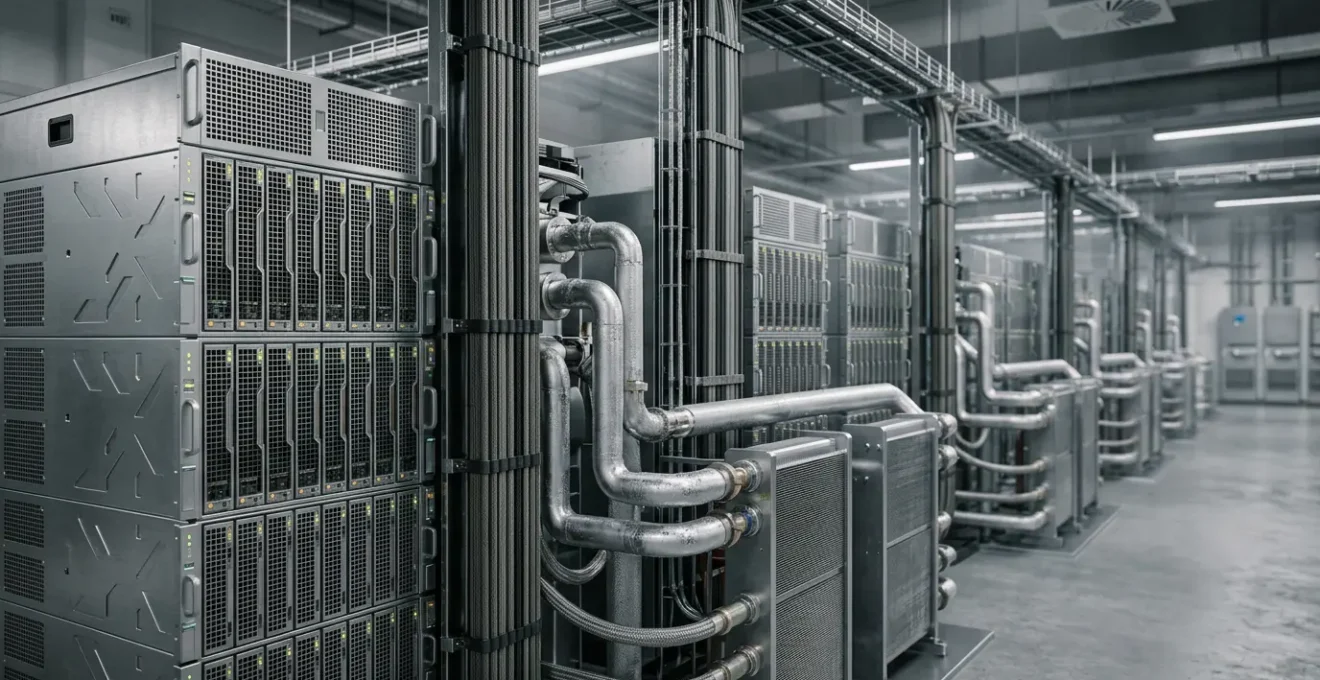
When perfectly optimized code still underperforms, the bottleneck is no longer logical—it’s physical.
- True performance gains are found by targeting physical constraints like memory bandwidth, thermal headroom, and architectural mismatches.
- Simply adding more cores or RAM is an inefficient strategy without a holistic analysis of the entire data path.
Recommendation: Shift your focus from iterative code-tweaking to a systematic audit of your hardware infrastructure to identify and eliminate the single slowest point in the system.
For high-performance computing (HPC) engineers and data scientists, hitting a performance wall is a familiar frustration. You’ve refactored algorithms, optimized every line of code, and squeezed every last drop of efficiency from the software stack. Yet, the application stalls, the models take too long to train, and the throughput remains stubbornly flat. The conventional wisdom of software-first optimization has reached its limit. This is the point where the focus must shift from the abstract world of code to the unyielding physics of silicon, copper, and heat.
The conversation must evolve beyond simple software parallelism. We often discuss leveraging multi-core processors or GPU acceleration, but the real challenge lies deeper. The problem isn’t a lack of processing units; it’s the physical pathways that feed them. This is where a Hardware Performance Specialist’s mindset becomes critical. The solution is not to simply add more, but to upgrade strategically, understanding that every component exists in a delicate balance. This article rejects the platitudes of just “buying better hardware.” Instead, it provides a framework for diagnosing the physical constraints that are truly throttling your computational power.
We will dissect the system layer by layer, from the CPU’s core limitations and the crucial role of RAM throughput to the economic realities of custom accelerators like FPGAs and ASICs. By adopting this hardware-centric approach, you move from being a programmer to being a true systems architect, capable of building machines that deliver on the promise of their theoretical power. This is about bottleneck hunting at the physical level, where the most significant performance gains now lie.
This guide provides a structured approach to identifying and resolving hardware bottlenecks. In the following sections, we will delve into the specific physical constraints that limit performance and offer concrete strategies to overcome them, allowing you to architect systems built for maximum throughput.
Summary: A Hardware-First Framework for Maximum Computational Throughput
- Why Your Multi-Threaded App Is Stalled by CPU Core Limits?
- How to calculate the RAM throughput needed for Real-Time Analytics?
- Why CPUs Struggle Where GPUs Excel in Matrix Multiplication?
- FPGA vs ASIC: Which Hardware Accelerates Crypto Mining Better?
- The Cooling Oversight That Throttles Your Server Performance
- Safe Overclocking: Pushing Server Hardware Without Voiding Warranties
- Why Direct Hardware Access Is Obsolete for Most Enterprise Apps?
- How to optimize HPC Data Centers for AI and Scientific Modeling?
Why Your Multi-Threaded App Is Stalled by CPU Core Limits?
The first instinct when a multi-threaded application underperforms is to blame the code. But often, the true culprit is a fundamental principle of parallel computing known as Amdahl’s Law. This law dictates that the maximum speedup of any program is limited by its sequential fraction—the part of the code that cannot be parallelized. For an application with even just 10% sequential code, you hit a theoretical wall. An analysis of Amdahl’s Law shows that such a workload has a 10x maximum speedup regardless of processor count. Throwing more cores at the problem yields diminishing, and eventually negligible, returns.
This theoretical limit is compounded by a physical one: memory bus contention. Each CPU core, while operating independently, must ultimately share access to system memory through a finite number of channels. As you add more cores, they increasingly compete for this limited bandwidth, creating a traffic jam on the data path. This is the digital equivalent of a multi-lane highway narrowing to a single-lane bridge.
As the visualization above metaphorically illustrates, even perfectly parallel tasks can be brought to a standstill if they are all starved for data. The processor cores are the engines, but the memory bus is the fuel line. If the fuel line can’t supply enough fuel, the power of the engines is irrelevant. This is why a system with a high core count but inadequate memory bandwidth will always underperform on data-intensive tasks. The bottleneck isn’t the processing; it’s the data path physics that govern access to information.
How to calculate the RAM throughput needed for Real-Time Analytics?
Moving beyond the CPU, the next critical area for bottleneck hunting is system memory. The common metric of RAM capacity (in gigabytes) is a misleading indicator of performance for real-time analytics. Capacity determines how large a dataset can be held in memory, but it says nothing about how quickly that data can be accessed. For workloads that involve rapid, iterative processing of large datasets, the key metrics are throughput and latency.
Throughput, measured in GB/s, defines the maximum theoretical bandwidth of the memory subsystem. As seen in the table below, this is heavily influenced by the RAM generation (e.g., DDR4 vs. DDR5) and configuration. Latency, measured in nanoseconds, represents the delay in accessing a piece of data. Lower latency is always better. A common mistake is choosing high-frequency RAM without considering its CAS Latency (CL) rating. True latency is a function of both speed and CL timing, and a seemingly faster module with poor timings can perform worse than a slower module with tighter timings.
Calculating the required throughput involves analyzing your application’s data access patterns. A real-time analytics workload that processes 10 GB of data per second requires a memory subsystem capable of delivering at least that much, factoring in overhead. This is where multi-channel memory architectures (dual, quad, or octa-channel) become non-negotiable. A single stick of RAM, no matter how fast, can only operate in a single-channel mode, effectively halving or quartering the CPU’s potential memory bandwidth.
| RAM Type | Speed (MHz) | Peak Transfer Rate | Typical Use Case |
|---|---|---|---|
| DDR3 | 1600 | 12.8 GB/s | Legacy systems |
| DDR3 | 1866 | 14.9 GB/s | High-end legacy |
| DDR4 | 2133 | 17.0 GB/s | Entry-level modern |
| DDR4 | 2400 | 19.2 GB/s | Mainstream |
| DDR4 | 3200 | 25.6 GB/s | Performance computing |
| DDR5 | 4800 | 38.4 GB/s | Real-time analytics |
Your 5-Step RAM Performance Audit
- Identify the CAS Latency (CL) rating from your RAM specifications (typically listed as CL14, CL16, etc.)
- Determine the RAM data rate in MHz (e.g., DDR4-3200 runs at 3200 MHz)
- Calculate true latency in nanoseconds using the formula: (CAS Latency × 2000) / Data Rate
- Compare configurations—lower latency values indicate faster memory response times
- Assess memory channel utilization—ensure RAM is installed in matched pairs or quads to maximize theoretical throughput
Why CPUs Struggle Where GPUs Excel in Matrix Multiplication?
When tasks are massively parallel, like the matrix multiplication at the heart of AI and scientific modeling, the limitations of a CPU become starkly apparent. This isn’t a flaw in the CPU; it’s a result of an architectural mismatch. A CPU is a generalist, designed for versatility. It’s composed of a few highly complex and powerful cores, each capable of executing a wide range of instructions and handling complex branching logic with very low latency. Think of a CPU core as a master artisan with a vast array of specialized tools, capable of crafting almost anything with intricate detail.
A GPU, on the other hand, is a specialist. It contains thousands of simpler, less powerful cores. These cores are designed to do one thing exceptionally well: perform the same simple mathematical operation on a massive number of data points simultaneously. Think of a GPU as a vast assembly line, where thousands of workers perform the same repetitive task in perfect unison. For a task like matrix multiplication, which involves millions of independent additions and multiplications, the assembly line approach is vastly more efficient.
The CPU’s strength in handling complex, sequential tasks becomes its weakness here. Its sophisticated logic for branch prediction and out-of-order execution is largely wasted on the repetitive nature of matrix math. The overhead of managing tasks across its few powerful cores is far greater than the GPU’s approach of throwing a horde of simple cores at the problem. This is why, for deep learning and simulations, a single high-end GPU can outperform a multi-socket CPU server by orders of magnitude. The key is matching the hardware architecture to the workload’s fundamental structure.
FPGA vs ASIC: Which Hardware Accelerates Crypto Mining Better?
When even a GPU isn’t specialized enough, the path leads to custom silicon. Here, the primary decision is between a Field-Programmable Gate Array (FPGA) and an Application-Specific Integrated Circuit (ASIC). FPGAs are like blank slates of logic gates that can be configured and reconfigured in the field to perform a specific function. ASICs are custom-designed chips built from the ground up for one single purpose. For a task like cryptocurrency mining, which is a singular, repetitive algorithm (e.g., SHA-256), the choice has a clear technical winner. An ASIC will always be superior in performance and power efficiency. Industry analysis shows ASICs are often 10x faster, with 10x lower power consumption, and a 10x smaller die size compared to an FPGA programmed for the same task.
However, the technical answer is only half the story. The decision is ultimately an economic one, dictated by the Economic Viability Threshold. FPGAs have high per-unit costs but zero upfront development cost. ASICs have incredibly low per-unit costs but require a massive upfront investment in Non-Recurring Engineering (NRE) costs for design, verification, and fabrication.
ASIC NRE Cost Break-Even Analysis for Volume Production
ASICs require Non-Recurring Engineering costs that can run into millions of dollars, while the final per-die cost can be mere cents. In contrast, FPGAs have no NRE costs but their per-unit price is significantly higher. The cost curves for these two technologies intersect at a specific production volume. For industrial-scale crypto mining operations, this break-even point is where the superior efficiency of the ASIC—measured in lower power cost per hash—begins to offset the massive initial development cost. This typically happens at large-scale deployments where the investment is recouped within 12-18 months of continuous operation, making ASICs the only economically viable choice for serious, long-term mining.
For crypto mining, the stability of the algorithm and the scale of the operation mean that crossing the economic viability threshold for ASICs is not just possible, but necessary to remain competitive. The superior power efficiency directly translates to lower operational costs, a critical factor in a business with tight margins. FPGAs remain valuable for prototyping or for mining newer cryptocurrencies with unproven or evolving algorithms, but for established coins, the raw power and efficiency of an ASIC are unmatched.
The Cooling Oversight That Throttles Your Server Performance
One of the most insidious and commonly overlooked bottlenecks is not a component, but a condition: heat. Modern processors are designed with self-preservation mechanisms that trigger when temperatures exceed a certain threshold (TJ Max). This mechanism, known as thermal throttling, dynamically reduces the processor’s clock speed and voltage to lower heat output and prevent physical damage. While this is a crucial safety feature, it is also a silent performance killer. You may have the most powerful CPU or GPU on the market, but if your cooling solution is inadequate, you will never access its full potential.
The performance impact is not trivial. For large GPU clusters used in AI training, inefficient cooling can be devastating. Research indicates that up to 25% of theoretical maximum performance is lost to thermal throttling in poorly cooled environments. This means a one-million-dollar hardware investment could be delivering the performance of a $750,000 system, simply due to an oversight in thermal management. The problem extends to all high-performance components, with modern NVMe SSDs capable of losing 50-70% of their performance when they overheat.
The battle against heat is fought at the micro level, right at the point of contact between the processor die and its heatsink. The quality and application of the Thermal Interface Material (TIM) is paramount. This paste or pad fills the microscopic imperfections on both surfaces to ensure efficient heat transfer. A poorly applied or degraded TIM creates thermal hotspots, triggering throttling even when the overall system temperature seems nominal. Effective thermal management is a core tenet of performance engineering, not an afterthought.
Safe Overclocking: Pushing Server Hardware Without Voiding Warranties
The term “overclocking” often evokes images of manually pushing frequencies in a server’s BIOS, a practice that almost universally voids warranties and risks instability. However, the modern approach to extracting maximum performance is far more sophisticated and aligns with manufacturer-supported technologies. Instead of crude manual adjustments, today’s performance tuning is about intelligently managing the processor’s built-in thermal power budget. This allows administrators to push hardware to its limits safely and within the bounds of its warranty.
Modern enterprise CPUs operate within a complex set of power and thermal rules. They are designed to “boost” their clock speeds opportunistically as long as they remain within a defined power limit (PL1/PL2) and thermal envelope. The art of safe overclocking is not to force a higher frequency, but to optimize the conditions that allow the processor’s own firmware to maintain its highest boost state for longer periods.
The Modern CPU Power Budget Re-allocation Paradigm
Rather than manual overclocking via frequency multipliers, modern enterprise tuning leverages manufacturer-supported technologies that allow administrators to adjust power budgets (PL1/PL2) and boost duration windows. By providing a superior cooling solution and ensuring adequate power delivery, you are essentially telling the CPU’s firmware that it has more thermal and power headroom to work with. The processor will then intelligently and safely maximize its own clock speeds. As an analysis from the experts at Puget Systems explains, most modern CPUs have thermal limits (TJ Max) between 95°C and 110°C and are designed to approach these temperatures under intense loads while remaining fully within warranty, provided operations stay within the manufacturer’s specified power parameters.
This paradigm shift means performance tuning has become a task of holistic system optimization. By investing in a more robust cooling solution or a higher-quality power supply unit (PSU), you are not just improving reliability; you are directly enabling higher sustained performance. The processor’s firmware handles the fine-grained adjustments, ensuring stability and component longevity. This is about creating an ideal operating environment where the hardware can safely unlock its own latent potential.
Why Direct Hardware Access Is Obsolete for Most Enterprise Apps?
In the quest for ultimate performance, it’s tempting to think that bypassing all software layers and communicating directly with the hardware is the ideal solution. This “bare-metal” approach promises the lowest possible latency by eliminating the overhead of the operating system and hypervisor. However, for the vast majority of enterprise applications, this thinking is not only outdated but also dangerous. The layers of abstraction that “direct access” seeks to circumvent are not just overhead; they are essential for security, stability, and manageability.
An operating system’s kernel manages resource allocation, ensuring that multiple processes can run concurrently without interfering with one another. A hypervisor allows for the virtualization of hardware, enabling the flexibility, scalability, and workload isolation that are foundational to modern cloud computing. Attempting to bypass these layers for a marginal performance gain introduces massive complexity and brittleness. A single poorly written instruction could crash the entire system, a risk that is unacceptable in an enterprise environment.
More importantly, these abstraction layers are a critical line of defense against hardware-level security threats. They provide a managed and vetted interface to the hardware, which is crucial for mitigating complex vulnerabilities. As one security analysis points out:
The layers of abstraction (hypervisor, OS) that ‘direct access’ aims to bypass are the very layers that help mitigate hardware-level security vulnerabilities like Spectre and Meltdown.
– Security Architecture Analysis
In a modern, interconnected world, sacrificing the security and stability provided by these battle-tested software layers for the allure of direct hardware access is a trade-off that is almost never worth making. The marginal latency saved is dwarfed by the immense security risks and operational fragility introduced.
Key takeaways
- Performance is ultimately capped by the serial portion of your code, a limitation defined by Amdahl’s Law that more cores cannot fix.
- True memory performance is a function of latency and multi-channel throughput, not just raw GB capacity.
- Specialized hardware (GPUs, ASICs) is mandatory for workloads that have a fundamental architectural mismatch with general-purpose CPUs.
- Thermal throttling is a silent performance tax; inadequate cooling can easily negate 25% or more of your hardware’s potential power.
How to optimize HPC Data Centers for AI and Scientific Modeling?
Optimizing a single server is a micro-level challenge; optimizing an entire High-Performance Computing (HPC) data center for demanding AI and scientific modeling workloads is a macro-level exercise in systems architecture. It requires applying all the principles of bottleneck hunting at scale, balancing performance, cost, and power consumption across hundreds or thousands of nodes. The goal is to create a cohesive ecosystem where compute, storage, and networking are in perfect harmony, ensuring that expensive processing units are never left idle, starved for data.
A key strategy in modern HPC design is to bring compute and data as close together as possible. This has driven the adoption of in-memory computing, where entire datasets are loaded into massive RAM pools to eliminate the latency of traditional disk-based I/O. Furthermore, the rise of specialized workloads necessitates a heterogeneous computing environment. A modern HPC data center is not a monolithic block of identical servers; it’s a diverse collection of nodes, some optimized with high-end GPUs for training, others with high-frequency CPUs for inference, and potentially even nodes with FPGAs for ultra-low-latency tasks.
The NVIDIA Jetson Edge AI Hardware Selection Framework
The challenge of hardware optimization is about finding the sweet spot between over-provisioning (wasted cost) and under-provisioning (crippled performance). As an analysis of the NVIDIA Jetson hardware selection process shows, engineers prototyping real-time object detection models often start with lightweight versions like YOLOv5s on mid-range hardware (e.g., Jetson Xavier NX). This allows them to benchmark real-world resource requirements before committing to more expensive, high-end devices like the Jetson AGX Orin. Optimization is a multi-faceted process, involving techniques like reducing model precision to FP16 to cut memory usage and leveraging vendor-specific libraries like TensorRT, which automatically fuse layers and tune kernels to fully exploit the hardware’s capabilities.
Ultimately, optimizing an HPC data center is not a one-time task but a continuous process of monitoring, analysis, and refinement. It requires a deep understanding of the specific workloads being run and the courage to make strategic investments in hardware that directly address the most significant physical bottlenecks in the data path. It is the ultimate expression of the hardware-first performance philosophy.
The path to superior throughput is not in chasing theoretical benchmarks, but in the systematic analysis and elimination of physical constraints. The final frontier of performance is not in the elegance of your code, but in the raw power of a well-architected system. Begin your hardware audit today.